Choosing the right injection needle is an important part of professional aesthetic treatments. Needle diameter, length, tip design, and internal structure can influence injection control, formulation delivery, and patient comfort. For aesthetic clinics and medical consumable distributors, understanding these factors is essential when selecting suitable products.
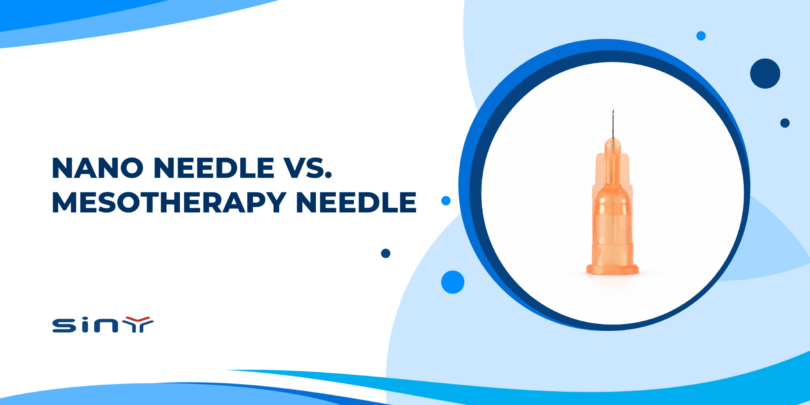
The comparison of Nano Needle vs. Mesotherapy Needle often creates confusion because these terms are sometimes used interchangeably in the cosmetic injection industry. Both products may feature fine stainless-steel cannulas, sharp tips, and short needle lengths. However, they are not necessarily identical in design, specifications, or intended applications.
A nano needle generally refers to an ultra-fine injection needle marketed for precise aesthetic procedures. In contrast, a mesotherapy needle is typically selected for intradermal injection techniques. These categories can overlap, and certain nano needles may also be suitable for mesotherapy procedures.
For buyers, the most useful comparison goes beyond product names. Understanding needle gauge, length, wall construction, and formulation compatibility helps clinics select appropriate instruments and allows distributors to make more informed purchasing decisions.
This guide explains the key differences, common applications, technical considerations, and purchasing factors that matter when choosing between these two needle categories.
What Are Nano Needles and Mesotherapy Needles?
Before comparing their performance, it is important to understand how each term is used in the aesthetic medical industry.
What Is a Nano Needle?
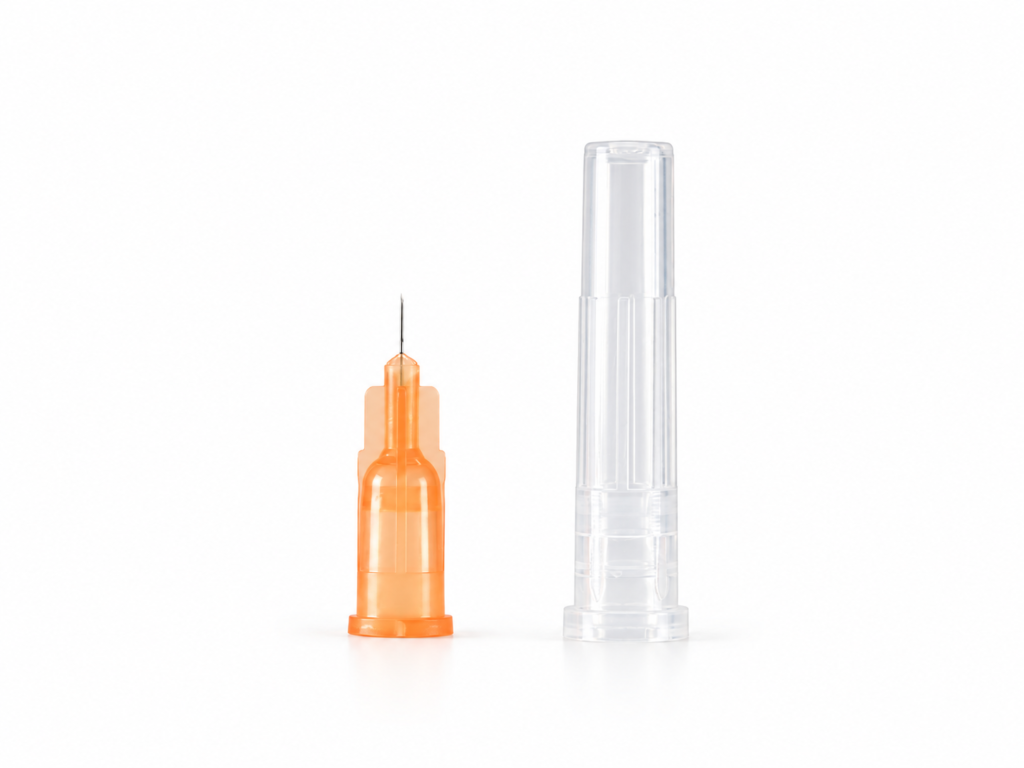
A nano needle is a fine-gauge injection needle commonly used in professional aesthetic procedures. Despite its name, the term does not necessarily describe a needle with nanometer-sized dimensions.
In the cosmetic injection market, “nano needle” is primarily a commercial product description rather than a universally standardized needle classification.
A hollow nano injection needle contains an internal lumen that allows liquid formulations to pass through the cannula. This distinguishes it from non-injectable nano-microneedling tips, which may use microscopic projections for superficial skin treatments without conventional injection.
Nano needles are available in different gauges and lengths. Their fine external diameters make them relevant to procedures requiring controlled injections, provided the needle is compatible with the intended formulation and technique.
At Siny PRP, our nano needle range includes gauges from 28G to 34G, with listed lengths of 1.5, 2.5, 4, 6, 8, 10, and 13 mm.
These options give professional buyers several dimensions to consider. However, exact gauge-and-length combinations should be confirmed before ordering.
What Is a Mesotherapy Needle?
A mesotherapy needle is an injection needle used in mesotherapy, a technique involving multiple small injections into selected tissue layers.
Mesotherapy is associated with various medical and aesthetic applications, including certain skin rejuvenation and scalp treatment procedures. The technique, injectable formulation, and applicable regulations determine whether a particular procedure is appropriate.
Mesotherapy needles are often short and fine, helping practitioners perform controlled injections at the intended tissue depth.
Commonly marketed options include 27G, 30G, and 32G needles, with lengths such as 4 mm and 13 mm. Nevertheless, these are examples rather than fixed industry requirements.
Unlike the term nano needle, which generally emphasizes fine dimensions, mesotherapy needle describes a product in relation to an injection technique.
Why Do These Needle Categories Overlap?
The distinction is not always clear because both categories may use similar needle dimensions and construction.
For example, a 32G hollow nano needle and a 32G mesotherapy needle may have comparable external diameters. Their suitability for a procedure depends on additional characteristics, including length, internal diameter, needle wall design, and intended use.
As a result, a product marketed as a nano needle may also meet the requirements of certain mesotherapy procedures.
However, this does not mean every nano needle is suitable for every mesotherapy application.
For professional buyers, the correct approach is to evaluate actual specifications instead of relying on marketing terminology.
Nano Needle vs. Mesotherapy Needle: Key Differences
Although both categories are used in aesthetic medicine, several practical factors can influence needle selection.
The following comparison summarizes their common characteristics.
| Feature | Nano Needle | Mesotherapy Needle |
|---|---|---|
| Product Description | Fine-gauge needle marketed for precision injection | Needle selected for mesotherapy techniques |
| Needle Structure | Commonly a single hollow needle | Commonly a single hollow needle |
| Gauge Range | Often 30G–34G, although ranges vary | Commonly 27G–32G, depending on the product |
| Needle Length | Available in multiple short and medium lengths | Selected according to the injection technique |
| Main Consideration | Fine diameter and controlled delivery | Suitability for the intended intradermal procedure |
| Injection Resistance | Depends on lumen size, length, and formulation | Depends on the same technical factors |
| Typical Applications | Selected aesthetic injection procedures | Mesotherapy and related intradermal techniques |
| Product Overlap | May be suitable for mesotherapy | May have nano needle characteristics |
These are general market characteristics, not universal technical definitions. Individual products should always be evaluated according to their verified specifications.
Needle Diameter and Gauge
Needle gauge describes the approximate external diameter of the needle shaft.
In general, a higher gauge number indicates a smaller external diameter. Therefore, a 34G needle is finer than a 30G needle.
Fine-gauge needles may create smaller puncture openings. However, a smaller diameter does not automatically mean less pain, less bruising, or better clinical performance.
Patient discomfort depends on several factors, including injection technique, tissue characteristics, formulation properties, and individual sensitivity.
Furthermore, extremely fine needles may create greater resistance when delivering certain formulations.
For this reason, practitioners should balance needle diameter with the requirements of the procedure rather than automatically selecting the highest gauge.
Needle Length and Injection Technique
Needle length is another important consideration.
Short needles are often associated with superficial injection techniques, while longer needles may be selected when a different approach is required.
However, physical needle length does not directly determine injection depth.
Actual penetration depends on the insertion angle, the portion of the needle entering the tissue, anatomical characteristics, and practitioner technique.
For example, a 4 mm needle does not necessarily produce an injection depth of exactly 4 mm.
This distinction matters in mesotherapy because the intended tissue layer can vary according to the procedure.
Needle Construction and Product Delivery
Two needles with the same external gauge may perform differently.
Their internal diameters, wall thicknesses, and manufacturing characteristics can affect liquid flow and injection resistance.
Consequently, buyers comparing fine-gauge products should consider the entire needle construction, not just the gauge printed on the packaging.
A needle that works well with a low-viscosity liquid may not be suitable for a thicker formulation.
The appropriate choice depends on the injectable product, manufacturer instructions, and clinical technique.
Applications in Professional Aesthetic Treatments
Nano needles and mesotherapy needles are used in overlapping areas of aesthetic medicine. However, their suitability depends on the intended procedure and the characteristics of the injectable formulation.
Facial Aesthetic Procedures
Fine-gauge injection needles are commonly considered for selected facial aesthetic treatments.
In these procedures, practitioners may prioritize precise handling, consistent needle dimensions, and controlled product delivery.
For example, certain reconstituted botulinum toxin preparations are administered using fine-gauge needles. Nevertheless, the appropriate needle size depends on the product instructions, injection technique, and clinical requirements.
A nano needle may be considered when a procedure requires a fine needle and the formulation can pass through its lumen at an appropriate injection pressure.
However, choosing the finest available needle is not always the best approach.
Some injectable products have higher viscosity or specific manufacturer recommendations that require a different needle gauge.
In addition, anatomical location, injection depth, and professional training remain important considerations.
Skin Rejuvenation and Mesotherapy
Mesotherapy involves multiple injections into selected tissue layers.
Depending on the clinical protocol, the technique may be associated with certain skin rejuvenation procedures.
Commonly discussed injectable categories include mesotherapy solutions, selected hyaluronic acid formulations, and polynucleotide-based products. However, their composition, viscosity, approved indications, and permitted injection routes vary.
Because mesotherapy often involves repeated punctures, needle consistency and controlled handling are important.
Short, fine-gauge needles are commonly used in these applications. Some hollow nano needles may also be suitable when their specifications match the procedure’s requirements.
Nevertheless, the term nano needle does not establish compatibility with a particular injectable substance.
Clinicians must consider the formulation’s approved or otherwise legally permitted use, injection route, and manufacturer instructions.
PRP Injection Procedures
Platelet-rich plasma (PRP) is used in selected professional aesthetic and hair-related treatment protocols.
PRP is prepared from a patient’s blood and contains platelets suspended in plasma. Its composition can vary according to the preparation method, including differences in platelet concentration, leukocyte content, and other cellular components.
These differences can influence how a preparation behaves during injection.
Fine-gauge needles may be considered for certain PRP procedures. However, very narrow needle lumens can increase flow resistance and may be unsuitable for some preparations, particularly when cellular aggregation or fibrin formation occurs.
PRP should not automatically be classified as a high-viscosity injectable. Its handling characteristics depend on the preparation and whether activation or clot formation has begun.
For this reason, clinics should evaluate needle compatibility with their PRP preparation protocol rather than assuming that a higher gauge is always preferable.
The choice of needle should also account for the intended injection technique, clinical evidence, and applicable professional requirements.
Scalp and Hair-Related Procedures
Certain professional scalp treatment protocols involve intradermal injections.
In these settings, needle selection may depend on the treatment area, injection technique, and formulation characteristics.
Mesotherapy needles are commonly discussed in connection with scalp injection procedures. Fine-gauge nano needles may also be considered when their specifications are appropriate.
However, needle selection alone does not determine treatment effectiveness.
Clinical outcomes depend on the underlying treatment, patient characteristics, and supporting clinical evidence.
This is particularly important for products promoted for hair restoration, as not every injectable formulation has established effectiveness or regulatory authorization for the proposed use.
How Different Injectable Products Affect Needle Selection
Injectable products can differ substantially in composition, viscosity, and flow characteristics.
For clinics and distributors, understanding these differences is important when comparing needle specifications.
| Injectable Category | Examples | Needle Selection Considerations |
|---|---|---|
| Botulinum Toxin Preparations | Reconstituted botulinum toxin products | Follow product-specific instructions and compatible needle requirements |
| Mesotherapy Solutions | Selected vitamin-containing or other mesotherapy formulations | Evaluate composition, viscosity, injection route, and regulatory status |
| Platelet-Rich Plasma | PRP preparations | Consider cellular composition, aggregation, and flow resistance |
| Non-Crosslinked Hyaluronic Acid | Selected injectable HA formulations | Review formulation viscosity and manufacturer recommendations |
| Crosslinked HA Fillers | Gel-based dermal fillers | May require larger lumens or specific delivery systems |
| Polynucleotide-Based Products | PN or PDRN formulations | Confirm product-specific viscosity, intended use, and needle compatibility |
These categories should not be interpreted as universal recommendations for injection.
For example, crosslinked hyaluronic acid fillers often have different flow characteristics from low-viscosity solutions. Some may require greater injection force or manufacturer-specified needles.
Similarly, PRP preparations may contain cellular components that affect their handling characteristics.
Therefore, buyers should evaluate the specific injectable product rather than assuming that all products within a broad category behave identically.
Understanding Needle Gauge, Length, and Wall Design
For buyers comparing Nano Needle vs. Mesotherapy Needle, technical specifications provide a more reliable basis for selection than product names alone.
Three factors deserve particular attention: external diameter, needle length, and internal wall construction.
Understanding Nano Needle Gauge Sizes
Siny PRP offers nano needles from 28G to 34G.
The following table presents the nominal external diameters listed in our product catalogue.
| Gauge | Nominal Outer Diameter |
|---|---|
| 28G | 0.36 mm |
| 29G | 0.33 mm |
| 30G | 0.30 mm |
| 31G | 0.25 mm |
| 32G | 0.23 mm |
| 33G | 0.20 mm |
| 34G | 0.18 mm |
These values represent the catalogue’s nominal specifications. Actual dimensional tolerances should be checked against the relevant product documentation.
The gauge range allows buyers to compare different external needle diameters.
For example, a clinic evaluating 30G and 34G options should consider both the required needle diameter and the formulation’s ability to pass through the internal lumen.
The higher gauge is not automatically the better choice.
Available Needle Lengths
The Siny PRP nano needle catalogue lists the following lengths:
1.5 mm, 2.5 mm, 4 mm, 6 mm, 8 mm, 10 mm, and 13 mm.
These options may serve different professional injection requirements, depending on the specific procedure.
However, buyers should confirm the available combinations before ordering.
A listed range of gauges and lengths does not necessarily mean every gauge is manufactured in every length.
In addition, needle length should never be used as the sole basis for determining injection depth.
Regular-Wall vs. Thin-Wall Needles
Needle wall construction can influence the relationship between external diameter and internal lumen size.
Two common terms are:
- RW (Regular Wall): A conventional needle wall design.
- TW (Thin Wall): A thinner wall construction that may provide a larger internal lumen at the same external gauge.
When other conditions remain comparable, a larger internal lumen can reduce resistance to liquid flow.
This may be relevant when delivering formulations with different viscosities.
However, actual performance depends on the needle’s internal dimensions, length, and the liquid being injected.
The Siny PRP supplier catalogue identifies RW and TW needle designs. Buyers should confirm which wall types are available for their selected gauge and length.
Is a 34G Nano Needle Suitable for Every Injectable?
A 34G nano needle has a nominal external diameter of approximately 0.18 mm, making it one of the finest options in the Siny PRP catalogue.
Its small diameter may be useful in selected procedures involving compatible, low-viscosity solutions.
However, the narrow internal lumen can increase injection resistance, particularly with more viscous or particle-containing preparations.
For example, certain reconstituted botulinum toxin preparations may be compatible with fine-gauge needles when permitted by the product instructions and clinical protocol.
In contrast, some gel-like formulations may require a larger lumen or a different delivery system.
PRP preparations also require careful consideration because cellular aggregation or fibrin formation can affect flow through a narrow needle.
Therefore, buyers should not assume that a 34G needle is suitable for every aesthetic injectable.
The appropriate choice depends on formulation compatibility, needle construction, and clinical requirements.
Needle Quality and Manufacturing Consistency
Professional buyers should also examine manufacturing consistency.
Important characteristics include needle tip geometry, dimensional accuracy, cannula quality, and secure needle-to-hub assembly.
These factors can influence handling and product performance.
However, visual appearance alone cannot establish product quality or clinical suitability.
Before clinical use, buyers should verify the relevant product documentation, intended use, sterile status, packaging integrity, and applicable regulatory requirements.
For distributors, consistent specifications are especially important because clinics often prefer products that support familiar handling characteristics across repeat purchases.
How to Choose the Right Needle for Your Clinic or Distribution Business
Selecting the right injection needle requires a practical purchasing process.
Instead of choosing a product simply because it is marketed as a nano needle or mesotherapy needle, buyers should evaluate the actual requirements of their customers.
Step 1: Identify the Intended Application
Start by determining how the needle will be used.
A clinic performing superficial intradermal procedures may have different requirements from one using needles for other aesthetic injections.
For example, a clinic purchasing needles for selected mesotherapy procedures may prioritize short lengths and fine gauges.
A clinic working with PRP preparations may also need to consider cellular composition and potential flow resistance.
The intended tissue layer, injection technique, and injectable formulation should guide the selection process.
Step 2: Choose the Appropriate Gauge
Needle gauge should be selected according to the clinical procedure and formulation requirements.
A finer needle may be desirable when a smaller external diameter is important. However, it may also create greater injection resistance.
For example, buyers comparing 32G, 33G, and 34G options should consider the formulation’s viscosity, required flow characteristics, and any manufacturer-specified needle compatibility.
There is no universally correct gauge for every aesthetic injection.
Step 3: Confirm Needle Length and Wall Design
After identifying the required gauge, buyers should examine needle length and wall construction.
Shorter needles may be relevant to certain superficial procedures, while other applications may require different dimensions.
Where RW and TW designs are available, buyers should compare their internal dimensions and intended applications.
For Siny PRP nano needles, the catalogue provides a range of gauges and lengths, but the exact model combinations should be confirmed before purchase.
Step 4: Check Syringe and Formulation Compatibility
Needle compatibility is an essential purchasing consideration.
Buyers should confirm that the needle hub is compatible with the intended syringe connection.
Common syringe connection systems include Luer Lock and Luer Slip, but compatibility should never be assumed without product verification.
The injectable formulation must also be considered.
Some products require particular needle gauges or delivery systems. Others may not be suitable for very fine needles because of their viscosity, cellular composition, or other characteristics.
Following the formulation manufacturer’s instructions helps prevent unsuitable product selection.
Step 5: Review Product Documentation
Before purchasing injection needles in bulk, professional buyers should request the relevant technical and quality information.
A practical purchasing checklist includes:
| Purchasing Factor | What Buyers Should Confirm |
|---|---|
| Gauge | Required external needle diameter |
| Needle Length | Available length for the selected gauge |
| Wall Design | RW or TW availability, where applicable |
| Syringe Connection | Compatibility with the intended syringe |
| Formulation Compatibility | Suitability for the injectable product |
| Intended Use | Suitability for the proposed procedure |
| Sterile Status | Verified sterilization information |
| Packaging | Unit packaging and shipment configuration |
| Documentation | Applicable technical and regulatory documents |
| Supply | Minimum order quantity and lead time |
Documentation requirements vary between countries and product categories.
Therefore, distributors should verify the requirements of their destination market before importing or supplying medical injection products.
Step 6: Evaluate Long-Term Supply Requirements
For clinics, consistent needle quality and availability can help maintain established purchasing and operating procedures.
For distributors, a supplier’s ability to support the required specifications over time is equally important.
Before placing a bulk order, buyers should confirm available models, product documentation, packaging requirements, and expected delivery arrangements.
Siny PRP offers nano needles in gauges from 28G to 34G, with multiple listed length options for professional aesthetic product buyers.
This range provides a starting point for clinics and distributors evaluating fine-gauge injection needles for their specific purchasing needs.
Frequently Asked Questions
1. Are nano needles and mesotherapy needles the same?
Not necessarily. A nano needle generally refers to a fine-gauge injection needle, while a mesotherapy needle is selected for a particular injection technique. Their specifications may overlap, and certain nano needles may be suitable for mesotherapy procedures.
2. Are nano needles thinner than mesotherapy needles?
Some nano needles have smaller external diameters than commonly marketed mesotherapy needles. However, both categories can include similar gauge sizes. The actual dimensions should be compared rather than relying on product names.
3. What is the difference between 30G and 34G needles?
A 34G needle has a smaller nominal external diameter than a 30G needle. However, its internal lumen may also be narrower, which can increase injection resistance. The appropriate gauge depends on the formulation and clinical technique.
4. How do I choose between 32G, 33G, and 34G nano needles?
The choice depends on the required external diameter, formulation viscosity, injection technique, and manufacturer recommendations. Higher gauge numbers indicate finer external diameters, but they do not automatically provide better injection performance.
5. Can nano needles be used for PRP injections?
Certain hollow nano needles may be considered for selected PRP injection procedures. However, compatibility depends on the PRP preparation, cellular composition, needle dimensions, and clinical protocol. Very fine needles may not be appropriate for preparations prone to aggregation or fibrin formation.
6. Do nano needles cause less pain?
Fine-gauge needles may reduce certain aspects of tissue penetration, but pain depends on multiple factors. Injection technique, anatomical location, formulation characteristics, and individual sensitivity all contribute. No needle should be considered completely painless.
7. What needle length is commonly used for mesotherapy?
Commonly marketed mesotherapy needle lengths include 4 mm and 13 mm. However, the appropriate length depends on the procedure and intended tissue layer. Needle length does not directly determine injection depth.
8. What should distributors check before ordering nano needles in bulk?
Distributors should confirm gauge, length, wall design, syringe compatibility, formulation requirements, intended use, sterile status, packaging, regulatory documentation, and supply arrangements. Exact product configurations should be verified before placing an order.
Summary
The comparison of Nano Needle vs. Mesotherapy Needle shows that these products are not necessarily two completely separate injection technologies. Their differences mainly involve product positioning, available specifications, and the requirements of particular aesthetic procedures.
Nano needles are commonly associated with fine-gauge injection applications, while mesotherapy needles are selected according to the needs of specific intradermal techniques. In practice, their characteristics can overlap considerably.
For clinics and distributors, the most reliable purchasing approach is to evaluate gauge, length, internal needle construction, formulation compatibility, and verified product documentation. These factors provide a clearer basis for selection than marketing terminology alone.
Siny PRP supplies nano needles in 28G–34G with multiple listed length options for professional aesthetic product buyers. Explore our nano needle product range or contact Siny PRP to discuss available specifications, purchasing requirements, and suitable options for your business.