Choosing the right injection needle involves more than comparing gauge or price. For medical distributors, aesthetic clinics, and healthcare procurement teams, understanding Nano Needle vs. Insulin Needle is essential when selecting products for different injection applications. Although both categories include fine-gauge needles, their intended uses, connection systems, dimensions, and purchasing requirements can differ significantly.
Nano needles are commonly associated with precision-oriented aesthetic procedures, while insulin needles are designed specifically for insulin administration. Both may have similar outside diameters, and some insulin pen needles even use the word “nano” in their commercial names. This overlap makes it important to examine actual product specifications rather than relying on terminology alone.
For professional buyers, the key question is not simply which needle is thinner. It is which configuration offers suitable dimensions, syringe compatibility, and delivery characteristics for the intended application. This guide compares the technical features, clinical uses, and procurement considerations of both needle categories to support more informed purchasing decisions.
What Are Nano Needles and Insulin Needles?
Understanding how each needle category is defined helps buyers identify the right product for their target market.
What Is a Nano Needle?
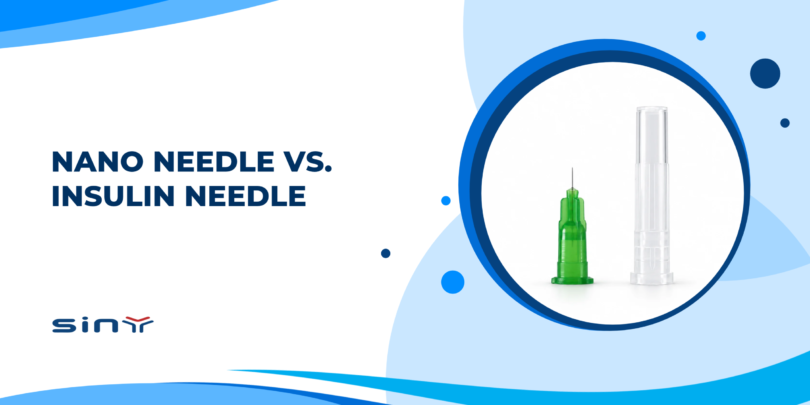
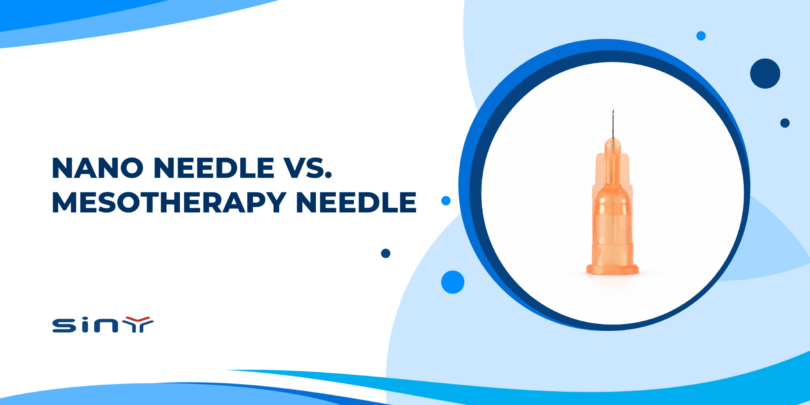
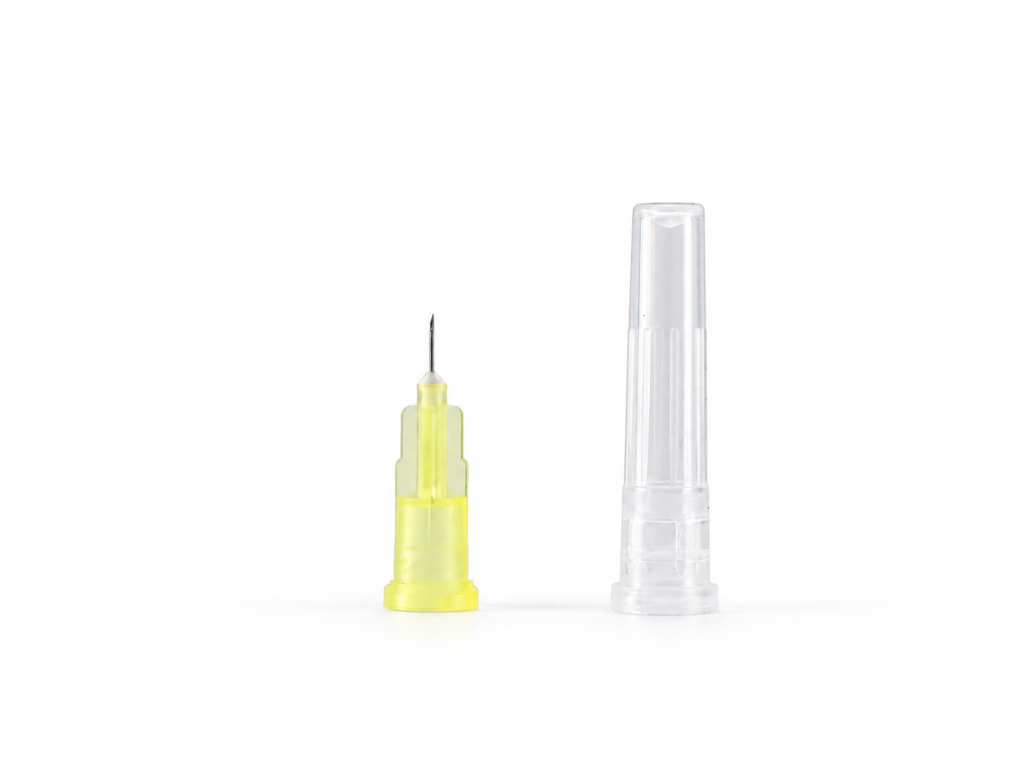
In aesthetic medicine, a nano needle generally refers to a fine-gauge injection needle used in professional procedures requiring controlled needle placement. Despite the name, these products are not necessarily manufactured with nanometer-scale dimensions. The term “nano” is commonly used commercially to describe particularly fine needle configurations.
In the aesthetic market, the term may also refer to non-hollow micro-tip skincare cartridges. However, this guide focuses specifically on hollow fine-gauge injection needles used for professional injectable procedures.
These needles are commonly considered for facial aesthetic injections, selected mesotherapy procedures, scalp-related treatments, and other professional applications involving appropriately sized fine needles.
Siny PRP offers nano needles in gauges ranging from 28G to 34G, with listed needle lengths of 1.5 mm, 2.5 mm, 4 mm, 6 mm, 8 mm, 10 mm, and 13 mm. The range provides different dimensional options for aesthetic clinics, medical distributors, and international buyers.
What Is an Insulin Needle?
An insulin needle is designed to deliver insulin into subcutaneous tissue. Two common configurations are insulin pen needles and insulin syringe needles.
Insulin pen needles attach to compatible insulin injection pens. They typically feature short, fine-gauge designs intended to support reliable subcutaneous administration.
Insulin syringe needles are integrated with insulin syringes and use insulin-specific unit markings rather than the standard milliliter graduations found on general-purpose syringes.
For example, U-100 insulin syringes are calibrated for insulin containing 100 units per milliliter, while U-40 syringes are calibrated for 40 units per milliliter. Using the wrong syringe calibration can result in serious dosing errors.
Modern insulin pen needles commonly include 31G and 32G configurations, with finer options available in certain product lines. Common lengths include 4 mm, 5 mm, 6 mm, and 8 mm.
Unlike the broader commercial category of aesthetic nano needles, insulin needles are defined primarily by their intended medication delivery application.
Why Are These Products Sometimes Confused?
Both categories can overlap in needle gauge and length. For example, a 32G nano needle and a 32G insulin pen needle may have similar outside diameters.
However, identical gauge numbers do not guarantee equivalent functionality. The products may differ in connection design, internal lumen dimensions, needle tip construction, and intended applications.
Additionally, some insulin pen needle products use “nano” in their commercial naming. Professional buyers should therefore compare complete product specifications rather than relying on product names alone.
Nano Needle vs. Insulin Needle: Key Technical Differences
The most important differences involve needle dimensions, fluid delivery characteristics, connection systems, and intended clinical applications.
Technical Comparison Table
| Feature | Nano Needle | Insulin Needle |
|---|---|---|
| Primary application | Selected aesthetic injection procedures | Subcutaneous insulin administration |
| Typical buyers | Aesthetic clinics, medical distributors, importers | Diabetes care suppliers, hospitals, pharmacies |
| Gauge options | Siny PRP range: 28G–34G | Commonly fine-gauge designs, including 31G and 32G |
| Needle lengths | Siny PRP range: 1.5–13 mm | Common pen needle lengths include 4–8 mm |
| Connection system | Standard Luer-compatible hub for Luer Lock and Luer Slip syringes | Insulin pen connection or integrated insulin syringe |
| Fluid delivery | Influenced by formulation, lumen, and needle dimensions | Designed for compatible insulin delivery systems |
| Injection route | Determined by the intended procedure | Primarily subcutaneous |
| Purchasing priority | Gauge, length, connection, and formulation compatibility | Device compatibility and insulin dosing requirements |
These differences explain why two needles with similar dimensions should not automatically be considered interchangeable.
Needle Gauge and Outer Diameter
Gauge describes needle size. In general, a higher gauge number indicates a smaller outside diameter. For example, a 34G needle is finer than a 30G needle.
The following table summarizes the nominal outside diameters in the Siny PRP nano needle range.
| Gauge | Nominal Outer Diameter |
|---|---|
| 28G | 0.36 mm |
| 29G | 0.33 mm |
| 30G | 0.30 mm |
| 31G | 0.25 mm |
| 32G | 0.23 mm |
| 33G | 0.20 mm |
| 34G | 0.18 mm |
The values represent nominal outside diameters. Actual dimensions are subject to the specified manufacturing tolerances.
A finer needle may be appropriate when a smaller outside diameter is desirable for the intended procedure. However, selecting the highest available gauge is not always the best approach. Internal lumen dimensions, formulation characteristics, and the required fluid delivery rate must also be considered.
How Needle Gauge Affects Injection Flow
Needle dimensions directly influence resistance to fluid flow. When other factors remain constant, a narrower internal lumen generally creates greater resistance. Needle length also matters: a longer needle typically produces more resistance than a shorter needle with the same internal diameter.
This relationship becomes particularly important when working with viscous formulations. However, needle gauge refers to outside diameter rather than internal diameter. Two needles with the same gauge may have different lumen dimensions because of differences in wall thickness.
For professional buyers, four factors deserve attention:
- Needle gauge determines the nominal outside diameter.
- Internal lumen dimensions influence fluid delivery resistance.
- Needle length affects the force required for injection.
- Formulation viscosity influences the practical choice of needle size.
A suitable needle should balance the required dimensions with effective fluid delivery rather than prioritizing the smallest possible diameter.
Needle Length and Injection Depth
Siny PRP’s nano needle range includes listed lengths from 1.5 mm to 13 mm, providing options for professional procedures with different working-depth requirements.
Insulin pen needles are commonly shorter because they are intended for subcutaneous administration while reducing the likelihood of unintended intramuscular injection.
Although a 4 mm nano needle and a 4 mm insulin pen needle may have similar working lengths, their intended applications and delivery systems may differ. Actual injection depth also depends on insertion technique, angle, and tissue characteristics.
Medical buyers should therefore evaluate needle length according to the intended clinical application rather than treating matching dimensions as proof of interchangeability.
Needle Connection Systems and Syringe Compatibility
Connection compatibility is an important distinction between aesthetic nano needles and insulin delivery products.
Siny PRP nano needles feature a standard Luer-compatible hub designed for use with compatible Luer Lock and Luer Slip syringes. This connection versatility supports different syringe preferences in professional aesthetic applications.
Luer Lock syringes use a locking mechanism to secure a compatible needle hub, while Luer Slip syringes rely on a friction-fit connection. A suitably designed standard Luer needle hub can work with both connection systems.
Insulin pen needles, by comparison, use dedicated interfaces designed for compatible insulin pens. These connections differ from standard Luer syringe connections. Insulin syringe needles are generally integrated into the syringe assembly.
For distributors, understanding these differences helps prevent compatibility errors and supports accurate product selection.
Which Needle Is Better for Different Medical Applications?
The appropriate needle depends on the intended procedure, formulation, and delivery system rather than the product category alone.
Nano Needles for Aesthetic Procedures
Fine-gauge nano needles are commonly considered for professional aesthetic applications requiring controlled needle placement. Practitioners may select different dimensions according to treatment area, injection technique, and formulation characteristics.
For example, a relatively low-viscosity solution may have different flow requirements from a more viscous preparation. A very fine needle provides a smaller outside diameter but may also increase injection resistance.
Consequently, aesthetic needle selection involves balancing diameter, length, lumen dimensions, and practical delivery requirements. Medical distributors supplying aesthetic clinics benefit from understanding these differences when developing their product assortments.
Insulin Needles for Diabetes Care
Insulin needles are designed for administering insulin through compatible delivery systems. For insulin pen needles, connection compatibility is essential. For insulin syringes, correct unit calibration is equally important.
A U-100 insulin syringe should not be treated as equivalent to a U-40 syringe because their unit markings correspond to different insulin concentrations.
Insulin delivery devices are also designed around the requirements of subcutaneous administration. These characteristics distinguish insulin needles from general aesthetic injection needles, even when their dimensions overlap.
Are Nano Needles More Comfortable?
Needle diameter can influence insertion comfort, but it is not the only determining factor. Needle tip geometry, injection technique, tissue characteristics, fluid viscosity, and injection speed can all affect the experience.
A smaller outside diameter may reduce certain aspects of tissue interaction, but it does not guarantee painless injection. Similarly, an insulin needle is not inherently less comfortable simply because it was designed for another medical application.
Professional buyers should evaluate documented construction characteristics rather than relying on broad comfort claims.
Can Nano Needles Be Used for PRP Injections?
Fine-gauge needles are used in selected professional PRP injection protocols, but the appropriate configuration depends on the preparation and procedure.
PRP formulations may vary in composition and flow characteristics. Very narrow needle lumens can increase injection resistance, while excessive mechanical stress under certain flow conditions may influence platelet integrity. The potential effect depends on needle dimensions, flow conditions, and preparation characteristics.
Another consideration is syringe dead space, the residual fluid volume remaining in the syringe and needle connection after injection. Some injection systems are designed to minimize this volume, while detachable needle connections may retain different amounts depending on their construction.
For clinics working with limited PRP preparation volumes, both injection resistance and dead space are useful considerations when selecting equipment. The appropriate needle should match the preparation, delivery system, and established clinical protocol.
How to Choose Nano Needles for Medical and Aesthetic Procurement
Selecting fine-gauge needles for professional purchasing requires a structured evaluation of technical specifications, application requirements, and supply considerations.
Step 1: Define the Intended Application
Start by identifying the procedure for which the needle will be purchased. Aesthetic clinics may require different configurations for facial treatments, scalp procedures, or other professional applications.
The intended procedure influences needle length, diameter, and delivery characteristics. Buyers should also identify the formulation and syringe system involved.
These details provide a stronger purchasing foundation than selecting a product based solely on its commercial name.
Step 2: Compare Gauge and Length Options
Once the application is defined, compare the available needle dimensions.
For example, buyers evaluating 30G, 32G, and 34G configurations should consider how differences in diameter may affect fluid delivery. The selected needle should provide an appropriate balance between outside diameter, working length, and injection requirements.
Siny PRP offers multiple fine-gauge nano needle options for professional purchasing evaluation. Buyers can select the required gauge and length combination according to their intended application and purchasing specifications.
Step 3: Confirm Syringe Compatibility
Before ordering, verify that the needle hub is compatible with the intended syringe connection.
Siny PRP’s standard Luer-compatible nano needle hub supports use with compatible Luer Lock and Luer Slip syringes. Insulin pen needles, however, use dedicated interfaces designed for insulin delivery devices.
Confirming syringe compatibility helps prevent purchasing errors and supports reliable product selection.
Step 4: Evaluate Needle Construction and Flow Requirements
Needle dimensions should be considered alongside the intended formulation. Relevant characteristics include tip construction, internal lumen, wall thickness, and injection resistance.
A narrower lumen may require greater force to deliver a formulation at a comparable rate. Where appropriate, professional buyers can evaluate samples using the intended delivery system under established testing procedures.
This approach helps identify configurations that meet practical application requirements.
Step 5: Review Product Documentation
Documentation availability and regulatory filings may vary by product SKU and destination market.
Procurement teams should identify the product specifications, intended-use labeling, sterility information, traceability records, packaging details, and technical documentation required for their market.
Relevant regulatory requirements should be considered during supplier evaluation and order planning. A clear documentation review helps ensure that the purchasing process aligns with the requirements of the intended destination market.
Step 6: Plan Bulk Orders Around Customer Demand
Medical distributors often supply multiple clinics with different product requirements.
Instead of ordering every available configuration in equal quantities, buyers can analyze customer demand and identify frequently requested gauges and lengths.
A practical purchasing plan should consider product assortment, order volume, packaging requirements, and replenishment schedules. Clear purchasing specifications also make repeat ordering more efficient.
Nano Needle Purchasing Checklist
| Purchasing Factor | Key Question |
|---|---|
| Intended application | What procedure will the needle be used for? |
| Gauge | What outside diameter is required? |
| Length | What working length is appropriate? |
| Lumen | Is the internal diameter suitable for the formulation? |
| Connection | Is the needle hub compatible with the intended Luer Lock or Luer Slip syringe? |
| Construction | Are the tip and wall characteristics appropriate? |
| Documentation | What technical and regulatory information is required? |
| Packaging | What packaging configuration is needed? |
| Order planning | Which specifications match customer demand? |
This checklist provides a practical framework for comparing fine-gauge injection needles before placing commercial orders.
Why Nano Needle Selection Matters for Medical Distributors
For medical distributors, selecting the correct needle specifications affects product positioning, purchasing efficiency, and long-term customer relationships.
Understanding Different Customer Requirements
Distributors serving diabetes care providers generally focus on insulin delivery products, while those supplying aesthetic clinics may require a broader selection of fine-gauge needles with different working lengths.
Although these products can overlap in dimensions, their commercial applications are different. Understanding these distinctions helps distributors build a more relevant product portfolio.
Reducing Specification Errors
Incomplete purchasing descriptions can create unnecessary confusion.
For example, requesting a 32G needle without specifying length or syringe compatibility may not provide enough information to identify the correct product.
A complete purchasing specification should include the intended application, gauge, length, and connection requirements. Where relevant, buyers should also identify formulation characteristics and documentation requirements.
This approach supports clearer communication during quotation and order confirmation.
Building a Practical Product Assortment
Offering multiple needle specifications can help distributors serve customers with different procedural requirements. However, a larger product range is not automatically more effective.
A well-planned assortment should reflect actual purchasing demand and the applications supported by each product. Distributors can use customer feedback, historical orders, and clinic requirements to identify priority configurations.
For international buyers, this approach can also support more efficient inventory planning.
Selecting a Suitable Supply Partner
When evaluating a supplier, medical buyers should look beyond the quoted unit price.
Clear specifications, consistent product identification, responsive communication, and appropriate documentation are important considerations for repeat purchasing.
Siny PRP offers a range of fine-gauge nano needles for buyers sourcing aesthetic injection supplies. With multiple gauge options, listed needle lengths, and a standard Luer-compatible hub, the product range provides practical purchasing choices for medical distributors and aesthetic clinics.
By defining technical requirements before ordering, buyers can compare products more effectively and establish a clearer procurement process.
Frequently Asked Questions
1. What is the main difference between a nano needle and an insulin needle?
The primary difference is their intended application. Nano needles are commonly marketed for selected aesthetic injection procedures, while insulin needles are designed for insulin administration. Their gauges may overlap, but their connection systems, dimensions, and intended uses can differ.
2. Is a nano needle thinner than an insulin needle?
Not necessarily. Both categories may include similar fine-gauge configurations. The actual outside diameter depends on the specified gauge rather than the product name.
3. What is the finest nano needle gauge offered by Siny PRP?
The Siny PRP nano needle range includes 34G as its finest listed gauge, with a nominal outside diameter of 0.18 mm.
4. Can insulin needles replace nano needles for aesthetic procedures?
They should not be considered automatically interchangeable. Suitability depends on the intended use, needle dimensions, syringe compatibility, formulation, and clinical protocol.
5. Are nano needles suitable for PRP injections?
Certain fine-gauge needles are used in professional PRP injection protocols. Selection should consider the PRP preparation, needle lumen, injection resistance, delivery system, and clinical technique.
6. Which nano needle gauge should aesthetic clinics choose?
There is no universal gauge for every aesthetic procedure. Clinics should evaluate the treatment requirements, formulation characteristics, working length, and syringe compatibility before selecting a configuration.
7. Does a higher needle gauge mean less pain?
A higher gauge generally indicates a smaller outside diameter, which may influence insertion comfort. However, the injection experience also depends on tip design, technique, formulation, and individual tissue characteristics.
8. What should medical distributors check before purchasing nano needles in bulk?
Distributors should review the intended application, gauge, length, lumen characteristics, syringe compatibility, product documentation, packaging requirements, and anticipated purchasing volume.
Choosing the Right Nano Needle for Your Business
Understanding Nano Needle vs. Insulin Needle helps medical buyers distinguish between fine-gauge products that may appear similar but serve different purposes.
Nano needles provide dimensional and connection options for selected aesthetic injection applications, while insulin needles are designed around the specific requirements of insulin administration.
The correct choice depends on the intended procedure, needle specifications, delivery system, formulation, and purchasing requirements.
For aesthetic clinics, medical distributors, and international importers, a specification-based purchasing approach supports informed product selection and efficient procurement.
Siny PRP offers nano needles in gauges ranging from 28G to 34G, with multiple listed needle lengths and a standard Luer-compatible hub suitable for Luer Lock and Luer Slip syringes. Explore our Nano Needle products at Siny PRP or contact our team to discuss the specifications that best match your purchasing requirements.